Showing posts with label human rights. Show all posts

Sunday, 26 February 2017

Dark times and how to survive them


There's nothing worse than a loss of hope. A feeling that nothing can ever get any better for us and those we love including all creatures great and small.

So, what do we do? Give into despair? Sometimes its not a matter of giving in so much as being dragged down by despair.
By life.

By constantly reading about all the nasty things that are happening to other people, both animal and human. By having our lives ruined by the actions of others who carry on, not so much oblivious to how what they do harms others, as not caring.

So, what can we do?

We can take the smallest thing, the smallest success and give it the credit it deserves.

Find something that makes us smile.


Pat ourselves on the back for the little things we achieve. Our kindness to others, not just the people we know but to strangers - especially strangers.

Most of all, during dark moments when we see no end to the darkness, to human cruelties inflicted on the voiceless, we need to remember who we are. Why we are here on this earth.

We are the compassionate ones and are here to make the world a better place. And, we are not alone.

And that's how veggiegirl2011 sees it.


Saturday, 1 November 2014

From wise men come wise words

Quote Of The Week - Carl Sagan, Scientist And Author


"If chimpanzees have consciousness, if they are capable of abstractions, do they not have what until now has been described as 'human rights'?

How smart does a chimpanzee have to be before killing one constitutes murder?"

Monday, 17 September 2012

My manifesto for a more compassionate world for human beings


When I was writing Living Cruelty Free, I did a lot of research for the chapter on ethical shopping and ways of making the world a better place.  

I was appalled by the cruelty shown to human beings. Sex trafficking is rife, so is slave labor and man's inhumanity to man is heartbreaking.  

Here are the things I think need to happen to improve people's lives -

1. A special court especially for children should be set up. This would give abused or neglected a voice. Any child anywhere can approach this court.

2. Companies to face prosecution for using slave or child labor. Every firm should have no excuse for not being able to account for every single stage of the supply chain. Any company caught using slave labor or child labor, will face massive fines with the money going to charities that help victims of child labor or and slave labor.

Child should be allowed to be children. Not forced to work.
 

3. Companies should provide suitable accommodation for all their workers. This accommodation must meet a minimum standard. They must also provide schooling facilities for workers' children.

4. Sick of people who win big money bitching about the 'burden' of having that much dosh? The stress of it all, of deciding what luxury item to buy next? Let's ease that burden for them by making it compulsory for lottery/Lotto winners who win big to donate a tenth of their winnings to charity.


5. Legalize prostitution. Too many women and young girls (and even young boys) are being forced into the sex trade. Legalizing prostitution so it's kept to safe, monitored buildings

Women will be safe, sex traffickers will be forced out of business.


6. Any country that doesn't have a democracy like China to be shunned by the international community.

 
7. All loopholes exploited by big business and individuals to be closed. Why should the poor pay a higher portion of their earnings than the rich who often pay nothing at all?
 
What would be in your manifesto?
I'd love to know. Please post a comment.

Sunday, 25 March 2012

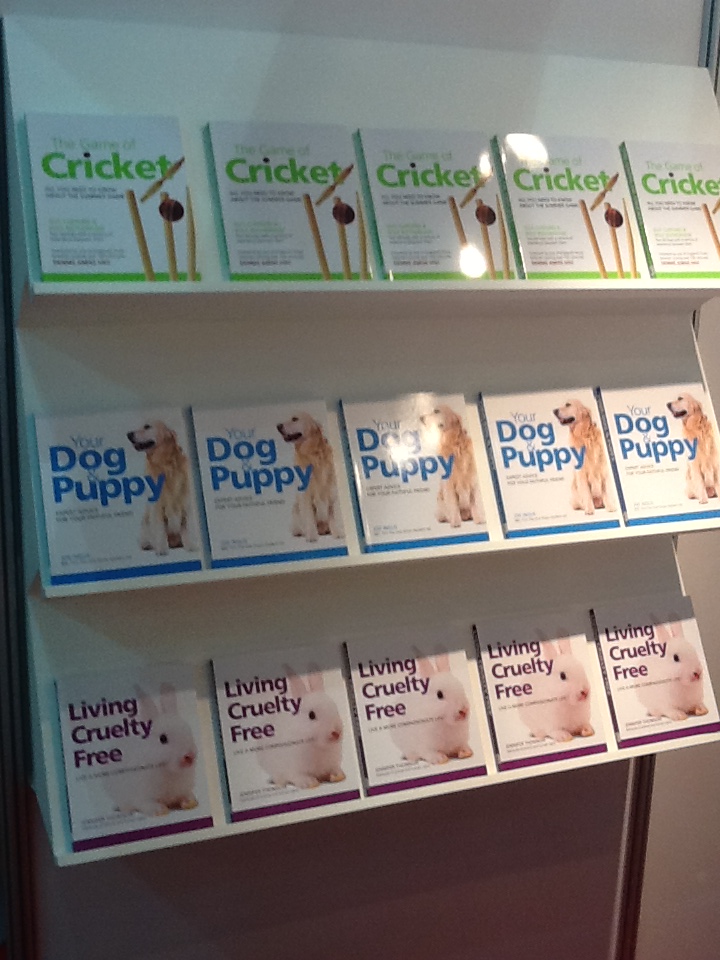
Why I wrote Living Cruelty Free

Living Cruelty Free is out on March 29th, available on Amazon.com & Amazon.co.uk
Also available at The Book Depository - they offer free worldwide shipping.

What’s in Living Cruelty Free?
The book focuses on ways to live a life that is more compassionate towards human beings and animals.

The chapters are as follows –
What's Cruelty Free?
Things that Can Never be Cruelty Free – this covers the cruellest things on the planet like fur, Foie gras, goose and duck down.
Going free-range & cage-free – I look at what free range means because it means something different depending on what country you live in. For example in America hens can be described as free-range as long as they have access to just five minutes of light a day.
Going Vegetarian or Vegan – as well as being aimed at new vegetarians and vegans, I also have useful information for people who are already vegetarian or vegan. For example, on the hidden animal sources nasties in foods.
Cruelty Free Cosmetics – It can be tricky to buy cosmetics and toiletries that are completely cruelty free. For instance just because a product says it’s not tested on animals may not mean its cruelty free. The ingredients may have been tested by their suppliers or the company that produced it may have benefited from animal research. To guarantee its cruelty free, it’s important to look out for the leaping bunny logo.
Shop Kind – This chapter is geared towards making people aware of the cruelty inflicted on their fellow human beings to make and produce the foods and products they buy. I cover child labour, slave labour and Fairtrade.
19 Ways to Create a More Compassionate World – These are equally split between helping human beings and helping animals. This is very important because I firmly believe that compassion towards human beings and animals goes hand in hand.
Become a Cruelty Free Crusader – proactive ways to make the world you live in a more compassionate place.
Useful Websites
Book List

Do you need to live in the UK for the book to be relevant?
No. The book is written in American English and when it covers laws and food labelling, the facts and laws given cover America, the UK, Canada and Australia, but most of the content is relevant to you wherever you live.

For instance, the majority of the world's fur comes from China, so the method with which it’s obtained is the same wherever it's sold.

What made you write the book?
I’ve been a vegetarian for 25 years and know from experience that there are many people out there who want to buy more ethical products that involve no animal suffering and are made by people who are paid fairly for their produce. There’s also a trend towards reducing the meat in your diet. Those people may not want to go the full hog and go vegetarian, but they do care about where the things they buy come from and whether they were tested on animals or caused animals any suffering.

Is the book only relevant to vegetarians and vegans?
Vegetarians and vegans will find it most useful, but no the book is not just aimed at vegetarians and is the perfect gift for vegetarians and vegans to give to non-vegetarian family and friends in an effort to encourage them to live a life that's more compassionate towards animals and humans.
Even if people read this book and stop eating veal and Foie gras (how many people know how both are made) and wearing fur or having goose or duck down in their bedding, I’ll have achieved something.

If you had to sum up the book's message, what would you say?
That with small steps, we can all make the world a kinder place: one that is more compassionate for people and animals.

Who do you see as the main readership of the book?
This is the ideal book for vegetarians and vegans to buy both for themselves - I've been a vegetarian who's been trying to live a cruelty free life for 25 years and in the course of my research I discovered some things that shocked me that I honestly wish I could unknow as they gave me nightmares.

I also hope that vegetarians and vegans will get thebook for family and friends to help them understand why they make the choices they do. Maybe it'll inspire them to make some changes themselves.

I also think non-vegetarians, who are interested in living a more compassionate life, will read the book as it also covers how to make the world a better place for humans too, with tips on how to avoid buying goods that are made using exploited labour and helping to ease poverty in the Third World.

What kind of response have you had to your companion blog?
I’ve been so pleased with the response to the blog and from people I’ve met via social network sites like Twitter and Facebook. I’m delighted to find that like me there are many people who despair about the cruelty in the world and want to help change things.

There are so many great blogs out there too that promote living a cruelty free life. It’s very heartening and proves there are people out there who do believe they can change the world.

What has been people’s reaction to Living Cruelty Free?
Most people have been positive and some friends and family who have read the book have said it’s made them more aware of the cruelty that goes on towards animals and made them more inclined to eliminate certain animal products from their diets. A few of them have even become vegetarian, including my mum.

They’ve also been shocked to read that some of the things they buy may have been made by child labour or slave labour and have said it’s more likely to make them buy Fairtrade.

Do you expect to get any criticism?
I know I'll probably be criticised for writing a living cruelty free book that doesn't simply say 'go vegan and stop using anything that's animal derived' but the truth its hard enough to get most people to eat less meat never mind no meat, milk, or eggs. I do my best though by highlighting the cruelty involved in obtaining these products.

The book's main message is an important one: that you can still make a difference to the welfare of animals with small steps like avoiding the cruellest foods on the planet like Foie gras, veal and fur. It doesn't mean I'm saying meat or eggs or milk are cruelty free - far from it - but I hope that by learning about the cruelty that goes into those things that people will have their eyes opened to the cruelty animals endure to end up as food on their plate and that they might veer towards vegetarianism.

Realistically though, most meat eaters will not stop eating meat and go vegetarian so the message is eat less meat and use less animal products to lessen the cruelty inflicted on animals, primarily by the meat trade. If every individual did that instead of thinking 'I eat meat so I might as well wear fur, eat veal etc because animals are here for humans to use' that will make some difference to the lives of farm animals.

For instance it might mean fewer animals are killed to be eaten or that particularly cruel foods like Foie gras are no longer considered acceptable things to eat. Look at the way fur is largely spurned in the UK now. There used to be furriers everywhere, but now they've all closed down because people's eyes were opened to the cruelty of fur so selling it became unacceptable and the furriers shut down.

Has doing the research changed you?
Yes, after 25 years of being a vegetarian I am now a vegan. After finding out about the cruelty that goes into milk production I had to make the switch.

Saturday, 24 December 2011

Living Cruelty Free is on its way!


Yay, Living Cruelty Free is now completed and is in the hands of the publisher. After auch a long journey to publication, I am looking forward to seeing it published. First as an ebook in January 2012 and then as a traditional book later on in the year.

One thing I am particularly glad of is that I no longer have to research the topics in the book. Things like veal, fur, foie gras. Reading about how these things are derived from such extreme cruelty has been heartbreaking.

What has been uplifting is reading about how so many people are turning their backs on things that come from such cruelty. In the UK where I live, people who wear fur are seen as social pariahs.

Another fact that makes me happy is that people's eyes are being opened to the cruelty involved in bringing low cost fashion to our high street chains. What's more, people are saying 'not in my name' and are shunning stores that sell wares made by slave labour (often child slave labour).

Together we can all make a real difference, I genuinely believe that and that's why I wrote Living Cruelty Free.

To be human is to show compassion to our fellow human beings and to animals. Those are words we can all live by.

Monday, 11 July 2011

Things I've learned whilst writing Living Cruelty Free

Writing Living Cruelty Free has been at times a distressing experience. I've had to research some things that were so upsetting I've had nightmares and wished that I could unlearn these things.


Things like what goes on in puppy farms, the shocking way that children are treated in Third World countries where they are taken advantage of by the suppliers to the big store chains to make things like clothes and toys, the appalling ways that animals are treated to make so called delicacies like veal and Foie gras.

There is one thing that I have come to realize whilst writing the book -
The countries with the shocking human rights records like China, are the ones with the worst animal abuses.

Could there be a link between human cruelty and animal cruelty? There definitely is. That's why in order to create a kinder, more compassionate world, we need to look out for each other and animals.

The other thing I have learnt is that we can never stop fighting for both human and animal rights, because there are so man people and animals who need our help.